SensComp News

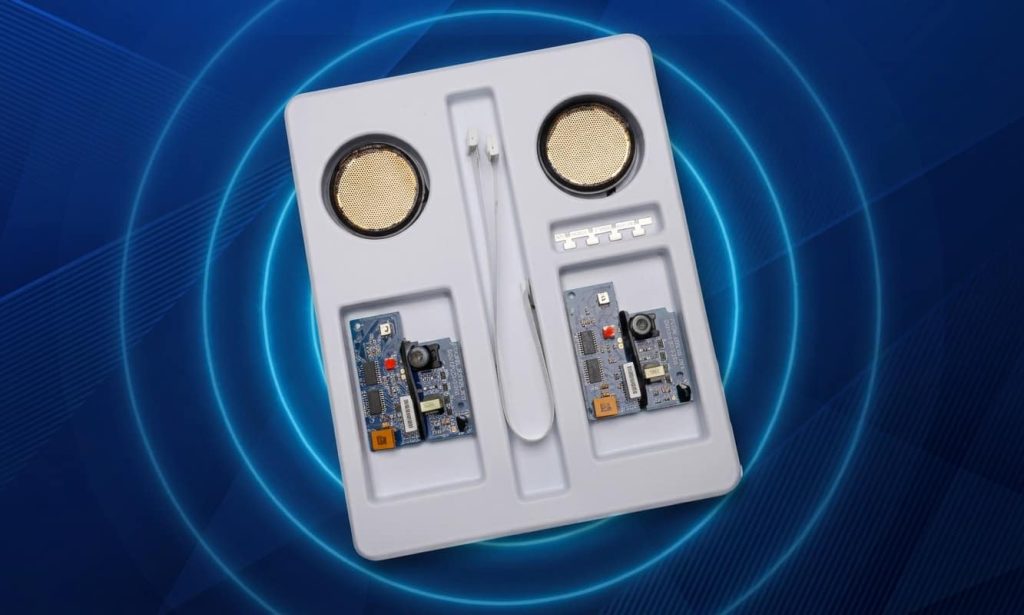
Electrostatic ultrasonic sensors using, multifrequency operation in a noisy environment.

How Multifrequency Operation Reduces False Ultrasonic Sensor Readings in Noisy Environments

Ultrasonic sensors can misfire in acoustically noisy environments, reporting obstacles that aren’t there when air brakes, machinery, whistles, or even animals put stray ultrasonic energy into the air. One effective way to reject that noise is multifrequency operation: transmitting a short stepped chirp of several frequencies as a unique signature, then accepting only the echo

How Multifrequency Operation Reduces False Ultrasonic Sensor Readings in Noisy Environments Read Post »

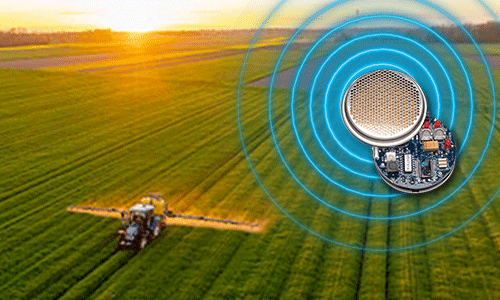
Aerial view of a farm field with sound waves illustrating electrostatic ultrasonic sensing in agriculture.

Why Piezo Sensors Struggle in the Field: The Engineer’s Guide to Agricultural Sensing

Electrostatic ultrasonic sensing gives agricultural equipment one rugged transducer for boom height control, tank level, and grain bin monitoring: detecting soft crop canopy, holding accuracy from -40°C to +85°C, and surviving chemical spray, in conditions where piezoelectric ultrasonic sensors lose the signal.

Why Piezo Sensors Struggle in the Field: The Engineer’s Guide to Agricultural Sensing Read Post »

Ski run with tracked fresh powder below a chairlift, where electrostatic ultrasonic transducers track snow depth

How to Measure Snow Depth Accurately in the Field with Ultrasonic Transducers

Electrostatic ultrasonic transducers measure snow depth reliably in unattended installations for weather stations, avalanche monitoring, ski slopes, and hydrology networks — resolving faint echoes off loose powder, holding accuracy in freezing dry air, and running for extended periods without recalibration. KEY ANSWERS AT A GLANCE Can ultrasonic transducers measure snow depth reliably? Yes. Electrostatic ultrasonic

How to Measure Snow Depth Accurately in the Field with Ultrasonic Transducers Read Post »

Students at a lab bench using an ultrasonic distance sensor, with sound waves visualized from the transducer.

What to Look for When Choosing Ultrasonic Sensors for Classroom Science Products

For OEMs building motion detectors, data-collection probes, and student distance sensors, four component-level decisions determine whether the finished product survives a real classroom or comes back as a warranty return. Students never see any of it — they see the plot on the screen — but the transducer, drive electronics, and connection hardware under the housing are what separate a tool students trust from one the instructor spends half the period recalibrating. Here’s your guide to choosing ultrasonic sensors for classroom science products.

What to Look for When Choosing Ultrasonic Sensors for Classroom Science Products Read Post »

Image of a SensComp electrostatic ultrasonic sensor next to a piezoelectric ultrasonic sensor.

Applications Where Electrostatic Ultrasonic Sensors Outperform Piezoelectric Sensors

Engineers evaluating ultrasonic sensors usually start in the generic category and assume every ultrasonic device performs about the same. They do not. Electrostatic ultrasonic sensors have approximately 40 dB greater sensitivity than comparable piezoelectric ultrasonic sensors, and that margin changes what the sensor can actually do in the field: longer usable range, reliable returns off small and soft targets, and stable readings as temperature swings. This post covers the specific applications where that difference is decisive, and why piezoelectric ultrasonic sensors may fall short in each.

Applications Where Electrostatic Ultrasonic Sensors Outperform Piezoelectric Sensors Read Post »

Shopping Cart
Scroll to Top